

There are a lot of levels and variables at play when it comes to self-defense / self-protection. Many of these aspects get overlooked in favor of perfecting a punch, kick or grappling technique. It’s understandable as physical techniques are a lot more fun. Not too many people want to sign up for a martial arts program only to sit down and take written notes from a lecture.
However, the most important aspect of protecting oneself is understanding the elements beyond physical defenses. If a situation results in a physical defense, it means we have most likely failed these other elements. These include understanding your surroundings. How safe is the area you are in? If you have a choice to walk down a public sidewalk versus a dark alley, obviously take the public sidewalk.
How prepared are you? If you can’t avoid a dangerous area, do you have quick access to a weapon or an escape plan? In this blog, I’m going to focus on some of these elements that get overlooked in training. Specifically focusing on breaking out of a habit, be it physical or mental. It’s one of the most common issues I see in students training as well as mistakenly getting into an altercation. These habits, be it good or bad, are a groove we have created that hold us on one pathway.
We must understand a part of the human condition when it relates to energy (calorie) conservation. The body has evolved to find ways to be efficient. I have detailed a portion of this in a previous blog post that I’ll link at the bottom of this post. It explains how our body and mind learn repetitive movements and skills. To briefly recap, it all starts with trial and error of a movement. Once the body concludes that the movement is ideal, it no longer spends the energy (calories) on the trial-and-error process.
It develops somewhat of a program that the brain sends to the muscles to accomplish the desired outcome. For instance, learning how to throw a round kick. When first learning, no matter how much you know about throwing the perfect round kick, the body simply won’t do it correctly the first time. It needs to learn which muscles groups need to be recruited to throw that kick the right way.
This uses a large amount of energy until both the body and mind conclude that it’s correct. From there, it just sends a signal to the muscles to “perform the round kick” and it will perform that kick in nearly the exact same way every time. This is much more energy efficient for the body. This is why we must train heavily, and with a lot of critique and feedback from your instructor. We need to make sure that your techniques are instinctual, and this can only be accomplished through proper repetition.
[Quick side note here as it relates, have you ever done ground sparring aka “rolling”? Do you remember the first time doing so? Do you remember being exhausted and possibly vomiting within thirty seconds? That is your body firing off an insane number of signals to all the muscle groups at once trying to figure out what to do, all while freaking out mentally. We’ve all been there.
I’ve had top level, highly trained, athletes run to the bathroom to vomit within one session of rolling. It’s not because they are not in shape. Their body is a well-conditioned system for what they do. But it wasn’t conditioned for rolling. And it burns through all the calories it has stored within seconds.
Anyone who has done ground fighting is laughing at the memory right now. It brings joy to my face watching egos get destroyed in less than a minute. After several rolling sessions though, your body learns what is useful and what is not and allows you to relax muscle groups that it doesn’t need to accomplish the task. Essentially, becoming very efficient.
Now back to your regularly scheduled program.]
But what if the technique isn’t correct? The body doesn’t care if it’s correct or not. It only cares if you have practiced the technique the same way numerous times over (hundreds, if not thousands of times). This is where bad habits arise. Changing a habit is considerably harder than creating the habit in the first place. Let’s say you learned to throw that round kick without pivoting your base foot. But your instructor wants you to pivot your base foot ninety degrees outward before you throw that kick as it will level out your kick for power and balance. Whereas without the pivot, the kick will have a somewhat upward trajectory.
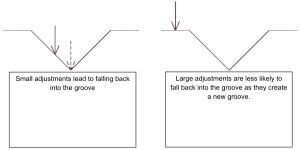
It may sound simple to just start pivoting before throwing your round kick. But it’s not. The smaller the adjustment, the harder it is to fix. You can slowly throw that round kick and do well with pivoting first, but as soon as you throw it fast in an instinctual way, it will go right back to the program it made that has you not pivoting for that kick. The body overrides what you want and will choose to do what it’s done a thousand times over.
It’s a tricky fix, but not impossible. Knowing that small adjustments are the hardest to fix, the best way to correct these small adjustments is to make bigger adjustments and then pull back. In the example given above with the round kick, I have students focus on angling their round kick downward from waist level. It forces the student to turn their hips over farther, which can only happen if they pivot their base foot outward.
Once they can consistently curve the kick downward through the target, it is now easier to pull back and flatten out the kick. It’s always easier to “pull back” on a technique than “push forward” so to speak. I remind students of this when it comes to power generation. If you practice by throwing soft punches that you pull every time, that is exactly how you will throw that punch in a real self-defense situation. You can’t suddenly throw it with power. But the opposite is possible. You can train for power and then pull back when not needed.
Physical grooves are not the only grooves, however. Anything that costs the body calories will create a groove to be more calorie efficient. Including thinking! Exhaustive thinking burns a lot of calories. In Daniel Kahnemans’ book, “Thinking Fast and Slow”, he mentions how deep thinking (slow) burns a lot of calories compared to a reactionary thought/response (fast) which burns very little.
The average person burns about one hundred calories per hour on average while doing normal everyday tasks. Compare that to a chess master who could burn upwards of three hundred calories per hour during a difficult competition due to the extreme focus and brain power needed to think through all the possible moves to compete. Much like how the body creates programs for physical responses (instinctual movements/responses) to conserve calories, it does the same for mental Reponses.
This is important to understand as it relates to self-defense. One thing I discuss in my self-defense courses/classes is that we need to practice responses beyond just physical responses. If the heart rate rises high enough (which it will in a sudden selfdefense situation), this will pull the blood away from muscles and organs the body doesn’t feel is necessary for survival.
This includes the frontal lobe, where logical thought resides. Meaning, you can’t stop and think through a situation until you lower your heart rate to exit the fight, flight, or freeze response. The body and mind will only do what it was trained to do. If you do not train verbal responses and commands during self-defense training applications, you are missing an element of your training.
For example, when applying some joint locks/holds or pressure points, it is imperative to repeat the command, “Down, down, down” to get the attacker to respond the way you want. Just because there is pain involved doesn’t mean the attacker will suddenly move the way you want to in some scenarios. Verbal commands are the most efficient way. Students must repeat these verbal responses while performing these techniques.
Understanding how the brain works in times of stress is also useful in de-escalation techniques. Let me paint a scenario here. You’re out at a bar one evening enjoying your time. You accidentally bump into another patron and cause them to spill their drink all over themselves. This person is now furious at you and is getting in your face stating how they are going to pummel you for what you have done.
Most people, in turn, get upset that they are being yelled at over an accident and the monkey dance begins. Each is getting louder and angrier. Eventually they can’t yell any louder and the fists start flying. I’ve seen this monkey dance happen more times than I care to remember. Understand that our emotions react faster than logical thought. When presented with, or placed into, a situation that we have never experienced, all we have to draw from is our emotions, which aren’t always useful.
This is yet another reason why martial arts/self-defense training is so important. It places you in these situations to give you the tools to navigate as safely as possible while staying calm with confidence. Our emotions are quick responses that begin to dictate our behavior in these situations. There are a couple things to remember when it comes to controlling your own behavior in this situation as well as how to de-escalate the situation.
First, understand it’s typically our ego that brings about these emotional reactions. We feel talked down to, embarrassed or “less than”. This is due to our ego. We all have an ego to one degree or another. But some struggle with it, even when it makes no logical sense. There was an interesting game created by economist Martin Shubik named the Dollar Auction that sheds some light on this monkey dance.
The game/auction involves auctioning off a one-dollar bill. People can bid any price, but it must be in increments of 5 cents or larger. Seems like a simple way to make money, right? But there’s a catch. The second highest bidder must also pay what they bid, even though they won’t receive the one-dollar bill. Meaning, if the top bidder bids $0.95 cents and the second highest bidder had a bid of $0.90, both bidders must pay, but only the top bidder receives the one-dollar bill.
The results of this auction regularly see people bidding well over $1.00 to win the auction for a one-dollar bill. As ridiculous as this may seem, the sense of loss is stronger than the sense of gain. Which results in the second highest bidder not giving up as they feel losing five cents (bidding $1.05) is better than losing $0.95 if they are the second highest bidder. It becomes a game of attrition, not logic. This same thing is going on with the monkey dance of two angry people who don’t want to lose. Even if “losing” simply means walking away or buying the other person a new drink to replace the one that was spilled.
From the outside looking in, this looks like a ridiculous fight over nothing. But emotionally, when the ego is involved, it feels like everything in the moment. This too is a groove we get stuck in. This brings us back to the two things we must deal with in this situation. How do we break out of our own groove of emotions that are propelling us to get into an unnecessary physical fight. And how do we break the other person out of this groove as well?
For the person who is on the receiving end, the person who accidentally spilled someone’s drink in the example above, the answer is two-fold. Focusing on breathing to calm the heart rate is imperative. This pulls you out of the fight, flight or freeze response or keeps you from entering it if done early enough. This allows you to think logically and make better decisions rather than responding with emotions.
The second part is to have a plan ahead of time. As stated earlier, training in these situations is incredibly useful as it gives you the verbal tools to de-escalate and the physical tools if all else fails. On the other hand, breaking the other person out of their emotional state is much more difficult, but not impossible. You can logically apologize to them and offer to buy them a new drink. But in an emotional state, that doesn’t always work. Especially if they feel their ego has been affected negatively.
Going back to what I mentioned earlier about thinking fast and slow, recall that thinking fast involves either emotions or trained responses. The individual that had their drink spilled on them is in that “fast” thinking mode going off emotions. The goal is to get them switched to “slow” thinking mode. This will force them out of the emotional responses and possibly get them to think through their actions, which always caters to better outcomes.
We do this by presenting them with questions that they want to answer that involves thought, builds their ego, and distracts them from their emotions. Apologizing and offering to buy them a new drink will only work if they are pulled out of the “fast” thinking mode. While there is no “one size fits all” solution, I’ll give an example of what could be helpful in this specific situation.
First and foremost, don’t get defensive. Be it verbally or physically. Take a literal step back and breathe. Then build his ego. “I can’t believe I did that, especially to such a nice shirt.” “I’m glad you didn’t just turn around and start pummeling me instantly like others would do.” “I’m obviously going to buy you a new drink, but is there anything else I can do to smooth this over?”
Note what has been done by using these statements. You’ve placed the blame on you, not them. You’ve built up his ego by complimenting his shirt and by stating how he’s better than others for not pummeling you. And by hitting you now, he’s proving he’s not as good as others. Then you finished by offering to fix the solution but also asking him if there is anything more you can do. This places his brain into slow thinking mode as there really isn’t anything else that can be done, but he may think about it more as if there is a good answer. You’ve taken away every reason for him to escalate the situation.
You may feel like you come across as a “lesser” person for apologizing and accepting the blame, but that’s mostly in your own head. Most people watching this situation (if any) are on edge during those moments thinking a fight is about to break out. But since it didn’t, it’s mostly just relief. And any perceived negative thoughts will be fleeting.
I know this works more times than not because I’ve been in scenarios like this. Sometimes I’m the one who made a mistake and I owned up to it just as stated above. Other times I’ve had friends step in to dissolve the situation immediately. Only once do I recall it getting physical as they grabbed my shoulder as if to hold me to punch me. A quick joint lock placed them on the ground unexpectedly.
They didn’t even realize I was the reason they were on the ground. I helped them back up, and since they were confused, it placed them back into slow thinking and the emotions went from anger to embarrassment that they “fell” to the ground. They simply walked away as I was the good guy who helped them up.
This is yet another reason why self-defense goes beyond just the physical. Understanding human behavior, a little bit of psychology, and instincts can dissolve most situations. Couple this with some properly placed, and subtle, physical techniques, and you can get through most situations unscathed and continue enjoying your day/evening.
Our body and mind are designed to fall into these grooves for efficiency. But that doesn’t always mean it’s a good thing. If your round kick is excellent, then that groove is fantastic. If it is subpar, then it’s a burden and potentially a big undertaking to fix. Same goes for our mental states. Our emotions are there for a reason. They are quick responses to keep us alive when needed. But other times those emotional grooves get us into trouble.
Martial arts are all about creating proper grooves for our lives, especially in altercations. Physical defenses must be instinctual to create a proper groove to use in bad situations. As mentioned at the onset of this blog, no one signs up for a martial arts program to listen to lectures and work on verbal reactions to conflicts. We must weave it into the program while not taking away from what brings people to classes. If self-protection is a priority, it is imperative to learn these de-escalation techniques to get ourselves and others out of the mental groove of escalation. The physical defenses are great, but they are meant to be the last resort, not the first.
Learn more about the “trial and error” process I mentioned in this blog. I’ve written in a little more detail how the body learns how to perform a physical movement using open and closed loop programs. It is discussed starting in paragraph twelve of Batteries May be Included but Loyalty Isn’t.








Leave A Comment