
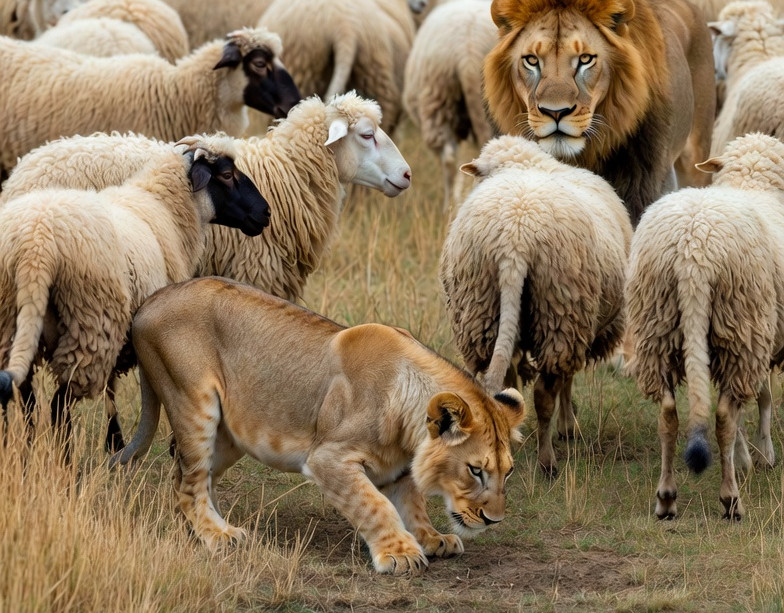
A pregnant lioness, barely clinging to survival, gave birth to a young cub. Upon giving birth, the lioness fell to its injuries, leaving the young cub all alone. The young cub, while wandering aimlessly with no sense of self or surroundings, spotted a herd of sheep nearby in a field and assumed he was a part of the herd. The sheep begrudgingly accepted the lion cub believing it won’t be dangerous if it is they who raise it.
Naturally, the cub grew up believing it was a sheep. Bleating instead of roaring, running and hiding from any perceived threat and staying close to the herd for safety. But due to the lions’ unusual look, the fellow sheep constantly looked down upon the now growing young lion. The young lion, with all the fears of a sheep, never fought back out of fear the sheep would harm it if it stepped out of line. It simply wanted to feel safe, even at the cost of ridicule and sadness for feeling different.
One day, a predator lion snuck up on the herd of sheep to attack. It launched forward with a vicious attack at the sheep looking for its next meal. The sheep scattered in fear! As the predator lion tore through the sheep, it came across the lion raised by sheep. The young lion was cowering in fear like all the other sheep. The predator lion stopped in confusion. “Why are you running in fear with these sheep”, the predator lion asked.
“Us sheep don’t want to be eaten by a predator like you”, the young lion responded while shaking in fear. The predator lion responded in anger and confidence, “you are not a sheep, you are a lion!” Confused, the young lion uncertainly stated, “No, I am but a fearful sheep.” The predator lion then took the young lion to a small pond nearby and stated, “look at your reflection, you are a lion!”
The young lion, looking down at his reflection, quickly realized the similarities between himself and the predator lion, while seeing no similarities with the sheep. The predator lion suggested, “give a roar, show them what you are!” Pushing through the unsettled nerves, the young lion took a deep breath and conjured up a decent roar.
Suddenly realizing how easy it was to roar, his confidence grew. Then his fear turned to ire towards the sheep that ridiculed him and pushed him around for being different and gave out an incredible second roar! The sheep, frozen in fear from realizing the error of their way, begged for forgiveness. The young lion, finally knowing who he was, gave mercy to the sheep and simply walked away with his fellow lion to hunt elsewhere with newfound confidence and strength.
I’ve read a few different versions of this story above but the general conclusion or moral of the story is about the importance of self-awareness. Self-awareness is not about who you think you are or who you want to be. Self-awareness is about how others perceive you. You could be the most confident person on earth, but if you are perceived as lacking confidence, you’ll be treated as if you have no confidence.
When it comes to self-defense and self-protection, self-awareness is incredibly important on two levels. First, it’s important to know what you are actually capable of. If you believe you can physically defend yourself against anyone, but you have never trained in doing so, that can lead to a terrible outcome. With a mistaken mindset of thinking you can handle yourself in an altercation, you’re more likely to overlook red flags of an attack or may even initiate a confrontation.
This makes you more likely to end up in an altercation, but without the training you could get seriously injured or killed. This is a false sense of security. Even people who train in martial arts, or some form of self-protection, fall victim to this. Sometimes we see the belt around our waste and make assumptions that we shouldn’t. While most instructors have set standards for a student to achieve to be awarded a rank such as black belt, that doesn’t mean that the student is fully capable of defending themselves.
For myself, I award black belts to students who have shown they both know and have instinctually trained the basics of the art they are learning. For my self-defense related arts, I also need to feel confident that students understand who they are and what they are capable of or not capable of when it comes to defending themselves.
Can they physically defend themselves against a basic attack from a basic attacker (random dude throwing a punch at you – no weapons, no friends jumping in to help, etc.), I believe so and so they do they. Even if it’s just to block or evade the punch and run. The mental state of someone with that kind of confidence is what can keep them safe and making good decisions when it’s backed up with knowledge is immeasurable. Essentially, this gives them a good sense of self-awareness on the physical level.
The second reason why having an accurate self-awareness is to understand how likely you will be a victim or not. You can classify personality types into three major categories. Shy/meek, extremely confident, and defensive. Shy would be someone that apologizes for breathing the air around you. If you bumped into them at a grocery store, they would apologize to you before you even realize what happened.
The extremely confident individual would be the type to go out of their way to create or enhance an issue. A small mistake on your end may end up sending them in a screaming rage. They are the type to feel the urge to take control of a situation or room as they feel they know better than everyone else, even if they know very little.
The defensive would be someone that tends to stay low, not get stirred up by many things, will apologize if it was actually their fault, but will verbally or physically defend themselves if they feel they have been wronged. This is the majority of us. We don’t seek out problems, but if they fall on our lap or we feel the problem needs to be fixed, we step up to deal with it.
While we can go into more detail and create numerous subcategories, these three help show us who is most or least likely to be a victim. The shy, meek, apologetic person is the most likely victimized by predators while the extremely confident personality types are the least likely to be victimized by a predator. The defensive personality profile is occasionally victimized, but since they tend to fight back, predators tend to move on.
The reason for this is easy to understand if you put yourself in the predator’s mindset. Note that a predator is just a name to identify anyone attempting to take advantage of or harm someone such as a thief, mugger, abductor, rapist, or even murderer. A predator didn’t become a predator by working hard in life. They perpetually take the easy way; legality and morals be damned. Understanding this mindset makes it clear why they would go after someone who is perceived as shy or meek. They won’t fight back nor cause problems and might even believe they themselves were at fault for being victimized, which they are not.
This is why someone who is perceived as high confidence is the least likely to be victimized by a predator. The predator knows they will fight back, cause a scene and even if the predator is successful, they will speak up and notify the authorities. It’s important to note, however, that high confidence people who are untrained in self-defense are more likely to be involved in a conflict by someone who is not a predator as they rub people the wrong way and are quick to argue.
You may have noticed that I’ve used the word “perceived” a couple times when referencing these personality types. That’s an important word to use as it’s the perception that matters. If you are a very confident person who is perceived as shy or meek, you’re more likely to be targeted, albeit less likely to be victimized as you would fight back. Predators scan large groups of people to determine their victim and make their decision based on perception. They don’t typically take the time to get to know you before attempting to victimize someone.
This all leads back to self-awareness. If you don’t know how you are perceived by others, you could be placing yourself in a bad situation, even if you may be well trained physically. The question we are then left with is, how do we discover how we are perceived by others to be accurate in our self-awareness?
First and foremost, we must know our astrology signs. I’m joking. Please don’t use astrology to determine who you are. There are a handful of ways we can self-assess how we are perceived by others. The real “first and foremost” is that we need to be honest with ourselves. This is what holds most people back. Sadly, most adults solidify their beliefs about themselves and the world by their mid-twenties and never look back. We must be open to learning every day, even if that means shattering what you currently think you know.
Understanding how our physical features can be seen by others is important, more than it should be unfortunately. And it’s not necessarily the same with men and women. Taller men tend to be perceived as more confident over shorter men, even if it’s completely untrue. Which isn’t necessarily the same when it comes to women. Some women that are taller are self-conscious of their height while shorter women could portray a lot of confidence. This is a cultural thing and can change from culture to culture.
Muscular, skinny, thinning hair or balding, the clothes we wear, our posture, so on and so forth can all send signals as to whether or not we are shy, confident or in between. This is obviously not definitive or universal, but people do get judged by looks when no other information is available. Needless to say, the shape or look of our face can be a big indicator of someone’s state of mind. Our emotions are regularly displayed on our face.
Once we have this honesty and openness to accept that we may be wrong about who we are and how our physical appearance can be perceived, the next step is to listen to others. Not just friends who may sugar coat everything but listen to everyone. That doesn’t mean to instantly believe everyone, just listen and then think honestly about it. I’ll give you a personal example from when I was a child. It was the final days of elementary school and the teacher had us draw up a small picture describing every other student, as well as ourselves, in a box on a large paper we were given.
I saw myself as an athlete and to a lesser extent, an artist. I played every sport and I was consistently good. I regularly won athletic tests/competitions in P.E. class or was at least among the top few. I did a lot of drawing and sculpting as well in art class that won me some awards and even had a drawing published in a small magazine. I was quite confident that everyone in class would draw up one of those two things to describe me. Boy was I wrong.
While we were working on the project in class, one of the girls sitting in front of me turned around and asked me, “what are you good at? I can’t think of anything.” I was a little taken back and kind of just shrugged my shoulders and said, “Uh, I don’t know.” She proceeded to draw a picture of me just sitting there doing nothing, and wrote that I was, “good at doing nothing.” I brushed it off as we weren’t close friends and didn’t think much of it.
Then when everyone was finished, we left the drawings on our desks as we could all walk around and see what everyone else drew up. One by one I got a little more depressed. Aside from a couple friends drawing me doing something active or drawing, most just had me standing there doing nothing with similar descriptions of “nothing” or “being a wallflower” and so on. I never saw myself that way. It was hard to take admittedly.
I couldn’t just brush it off like I did with the first one. It was overwhelming that no one perceived me as who I thought I was. I knew I was good at both, but that didn’t matter when it came to how others perceived me. I had to accept it. At the time I didn’t really know how to deal with it or if it was something that I needed to overcome. But that perception has followed me ever since by those who don’t really know me.
The one good thing that I took from it though, was that people weren’t really paying attention to me or thinking of me as much as I assumed. One big issue that kids, and even adults, have is that we think everyone is constantly watching and judging us, which they are not. That part is freeing and helps let go of some anxiety over feeling embarrassed of the thought that everyone thinks negatively of you or analyzes everything you do. The point being, understanding how you are truly perceived can be jarring and tough to take at times, but it can also help you overcome perceptions you may not like.
I’d like to point out that you don’t have to change who you are if you don’t want to just to avoid being a victim. If you are naturally a shy person and have no interest in suddenly becoming a highly confident extravert, you don’t have to. It’s about how you portray yourself in situations where you may get noticed by a predator. There are little things you can do to adjust this perception. Looking people in their eyes while walking around the grocery store or at least not looking down perpetually.
Not apologizing for everything. If you haven’t done so yet, go read my post, A Sorry State of Mind, about not saying sorry and the mindset it creates. The way one walks, and their posture can also lead someone into perceiving one as shy or confident. Making adjustments like this can lower your chances of being victimized. And, of course, the biggest thing one can do is to learn self-protection through a proper martial arts class or regular course. This not only can help you spot red flags to keep you away from predators and help fight back but will also give you confidence in your ability to defend yourself. This has an outward effect of displaying a more confident perception.
Our environment and past experiences are huge factors in how we display who we are in regard to how others perceive us. Take the time to reflect on your past, your childhood, traumas, accomplishments and anything else that could lead you to who you have become. Recognizing that we may have been forced into believing we are scared sheep, but deep down, we might have a lion in us that we’ve kept chained up to please others.
Humans are complicated creatures. We aren’t just one thing, ever. Sometimes, we need to keep our heads down and be sweet like the sheep. Other times, we need to unleash the lion when appropriate. When we are honest with ourselves and truly know who we are and how we are perceived, we can avoid unnecessary conflict while also being able to deal with it when forced upon you.








Leave A Comment